PolyPave Global Inc.
PAVING & AGGREGATES FOR A SUSTAINABLE FUTURE.
PAVING & AGGREGATES FOR A SUSTAINABLE FUTURE.
Upcycling polymer waste into high-performance paving and structural aggregates.
Partner With UsHeadquartered in Ontario, Canada, PolyPave Global Inc. is an international engineering firm specializing in circular infrastructure and advanced polymer-fusion technology. The firm operates at the nexus of Environmental Engineering and Sustainable Manufacturing, providing scalable solutions for the global plastic waste crisis.
PolyPave Global is dedicated to de-risking infrastructure investment in emerging markets by deploying high-strength structural aggregates and interlocking paving units that exceed North American (ASTM) performance standards. By leveraging proprietary chemical engineering, the firm transforms localized waste streams into long-term sovereign assets, reducing regional dependency on imported petroleum-based binders.
Ontario-based research focused on polymer-fusion and material stress-testing.
Global PMP-led deployment of Micro-Factory modules across West Africa.
Ensuring strict adherence to PEO (Ontario) and ASTM international safety codes.
"Our mandate is to establish 'Circular Cities' globally, ensuring that the infrastructure of tomorrow is built from the recovered waste of yesterday through rigorous Canadian engineering oversight."
As a Professional Engineering firm, we align our operations with the United Nations Sustainable Development Goals to ensure our growth contributes to a better world.
Developing resilient, sustainable infrastructure by upgrading traditional materials with advanced polymer technology.
Creating "Circular Cities" where plastic waste is managed locally and converted into durable urban pathways.
Pioneering the upcycling of post-consumer polymers, diverting thousands of tons from landfills and oceans.
Upholding the highest standards of safety, transparency, and technical excellence in every interlocking stone we produce.
By integrating North American material science with localized manufacturing, we deliver an infrastructure solution that is non-porous, chemically stable, and significantly more durable than conventional alternatives.
Interlocking paving units with 50MPa compressive strength and zero water absorption.
Engineered gravels for road sub-base and structural fill, diverting tons of plastic from landfills.
Utilizing reactive processing to ensure UV stability and thermal resilience in tropical climates.
A vertically integrated approach to sustainable infrastructure, ensuring quality control from waste collection to final road installation.
Localized collection of HDPE, LDPE, and PP polymer waste streams.
Automated sorting, cleaning, and high-torque mechanical shredding.
Proprietary thermal bonding and structural aggregate blending.
Rapid deployment of interlocking stones for high-durability roads.
Standardized Performance Data for PolyPave™ Structural Units
| Property | Test Standard | PolyPave™ Value | Compliance Status |
|---|---|---|---|
| Compressive Strength | ASTM C67 / C140 | 62.5 MPa (Avg) | Exceeds Standard |
| Water Absorption | ASTM C140 | < 0.08% | Non-Porous |
| Flexural Strength | ASTM C293 | 8.4 MPa | High-Impact Resistant |
| Thermal Expansion | ASTM D696 | Minimal Distortion | Optimized for Tropics |
| UV Degradation | ASTM G154 (Cycle 1) | Reactive Stabilized | 25+ Year Lifecycle |
Note: All testing protocols are managed under the oversight of PolyPave Global’s Engineering Operations Division. Formal lab reports available to Ministry technical aides upon request.
Beyond engineering, we are building economic resilience and social equity.
Transforming marginalized waste-streams into sustainable livelihoods.
Establishing 200+ specialized manufacturing roles and 500+ indirect logistics positions per Micro-Factory, focused on youth and women empowerment.
Implementing a localized "Cash-for-Plastic" system that injects capital directly into the local economy, incentivizing community-led environmental cleanup.
Training local technicians in Ontario-standard (P.Eng) quality control and precision manufacturing, building a future-ready workforce for Nigeria.
PolyPave Global Inc. views plastic waste not merely as an environmental burden, but as a critical Public Health Risk. In rapidly urbanizing regions, plastic accumulation in drainage channels is a primary cause of stagnant water—the principal breeding ground for malaria-transmitting vectors and the root cause of destructive flash flooding.
Our "Waste-to-Wealth" model provides an active intervention strategy. By removing non-biodegradable polymers from the ecosystem and locking them into permanent, high-strength infrastructure, we directly contribute to flood mitigation and disease vector control. We are not just building roads; we are engineering cleaner, safer, and more resilient communities.
Reducing standing water and disease vectors through superior urban drainage design.
Converting non-biodegradable HDPE/PP waste into permanent, functional infrastructure.
A low-heat, low-carbon alternative to traditional Portland cement manufacturing.
PolyPave Global creates a "Triple Bottom Line" return: Profitability, Environmental Restoration, and Local Economic Empowerment.
Scale requires synergy. We partner with world-class institutions and government agencies to bridge the gap between material science and civil infrastructure.
Collaborating with a leading University and leading material scientists to validate polymer-modified bitumen performance and ASTM testing protocols.
Engaging with agencies like ISIPA to align our micro-factory model with national "Waste-to-Wealth" and import substitution mandates.
Maintaining PEO (Professional Engineers Ontario) standards of practice to ensure every meter of PolyPave road meets global safety benchmarks.
PolyPave Global is pioneering the "Waste-to-Road" Micro-Factory model. Our vision centers on localized manufacturing hubs that process region-specific plastic waste into high-performance infrastructure for that same community, creating a truly circular local economy. Click here to get started.
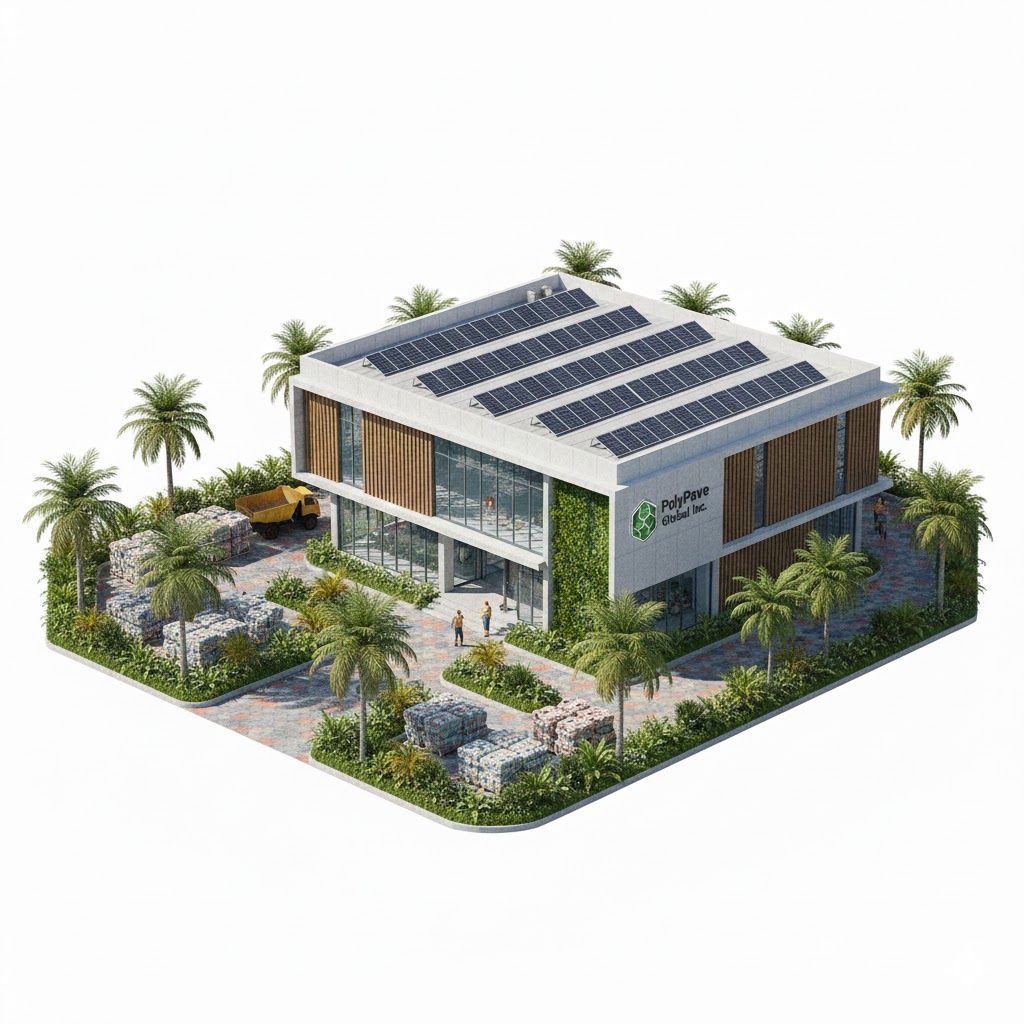
Our core manufacturing units feature high-torque extrusion lines and precision molding systems. Designed for scalability, these facilities convert diverse polymer streams (HDPE, LDPE, PP) into high-compressive-strength paving stones and structural aggregates with minimal energy overhead.
Click here now to get started.
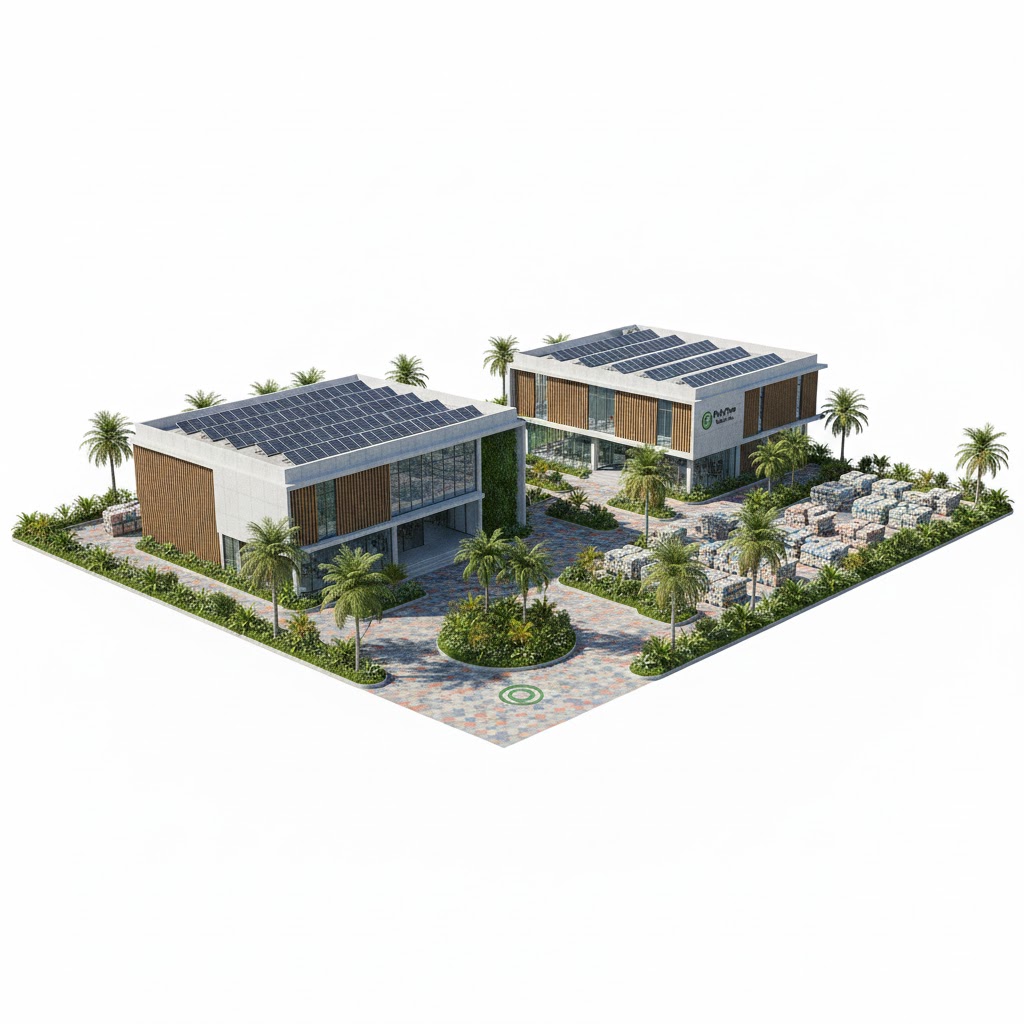
A master-planned logistical flow designed by engineers. The layout optimizes the sequence from raw waste intake and automated sorting to the final curing and palletizing of finished stones. This footprint is designed to be replicated across various municipalities to minimize transport carbon costs.
Click here now to get started.
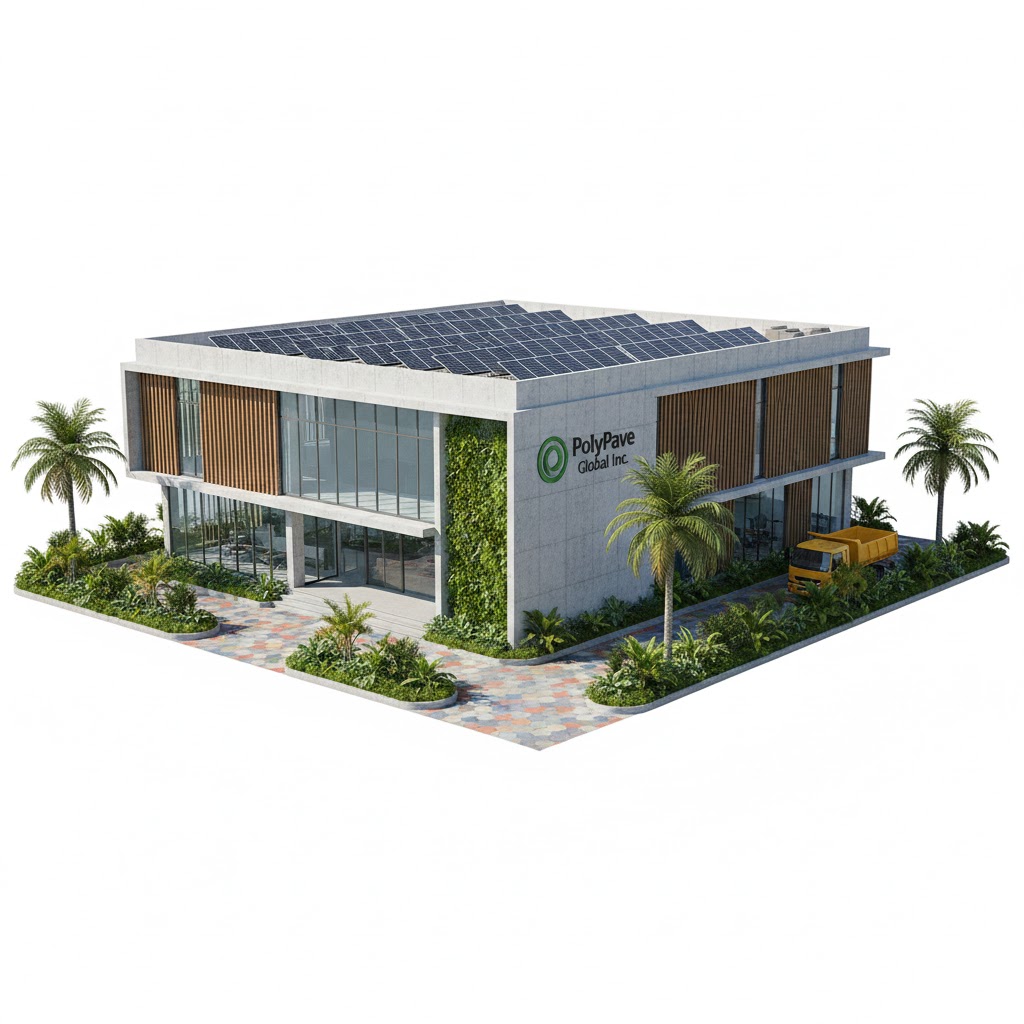
The brain of the operation. This center houses our quality control labs, where every batch is tested for ASTM standards, and our R&D wing, which focuses on advanced polymer-bitumen modifiers and future structural composite materials to keep PolyPave at the cutting edge of green tech.
Click here now to get started.
180-DAY STRATEGIC PILOT DEPLOYMENT
A high-efficiency roadmap for Pilot Deployment, subject to international logistics and administrative lead times.
Objective: Formalize the partnership with the Ministry of Environment.
Key Milestones: Site survey of Municipal waste streams; Technical identification of the first "Micro-Factory" footprint in coordination with the Ministry of Environment.
Objective: Material validation and machinery logistics.
Key Milestones: Laboratory testing of local HDPE/LDPE/PP feedstock at Canadian research labs; Fabrication and shipment of PolyPave™ thermal-fusion units from Canada to the location.
Objective: On-site setup and technical skills transfer.
Key Milestones: Installation of the Micro-Factory line; Specialized training of 50+ local technicians in North American QA/QC and precision manufacturing protocols under P.Eng. supervision.
Objective: Project handover and public launch.
Key Milestones: Demonstration of the paving of the first 250m "Smart-Drainage" road corridor in the Municipality; Official project commissioning by the Executive Governor and Ministry officials.
Project Timeline Integrity: While PolyPave Global Inc. utilizes PMP®-certified scheduling to target a 180-day commissioning window, stakeholders should note that the critical path is subject to external variables. Total project duration may be adjusted based on international maritime logistics (shipping/port clearance), inter-agency bureaucratic protocols, and site-access approvals.
Our Director of Engineering Operations provides bi-weekly status reports to the Ministry to ensure transparent communication regarding any force majeure or administrative lead-time variations.
ENGINEERING FOR OPERATIONAL CONTINUITY
Risk: Inconsistent plastic waste quality.
Mitigation: PolyPave™ proprietary thermal-fusion units utilize multi-stage sorting and "reactive stabilization" to neutralize impurities, ensuring consistent 55MPa output regardless of feedstock source.
Risk: Local power instability.
Mitigation: Every Micro-Factory module is designed with Integrated Energy Resilience, utilizing high-efficiency heat exchangers and optional hybrid-solar backups to ensure 24/7 production capability.
Risk: Lack of local spare parts.
Mitigation: Modular design philosophy. Our Canadian engineering team provides a 24-Month Critical Spares Kit with every deployment, coupled with remote diagnostic monitoring from our Ontario HQ.
Ready to transform regional plastic waste into high-performance infrastructure? Use the form below to request a Technical Feasibility Brief or to initiate the site-identification process for a PolyPave™ Micro-Factory in your municipality.
Addressing technical specifications and implementation logistics for stakeholders.
Yes. Our units are engineered for a compressive strength of 55-65 MPastrong, which exceeds the requirements for high-traffic urban corridors and industrial zones. They are designed to withstand heavy axle loads without the rutting or "shoving" seen in traditional asphalt.
We establish local collection hubs where citizens are paid a fair market rate per kilogram for specific polymer waste (HDPE/PP/LDPE). This creates an immediate micro-economy that incentivizes environmental cleanup and provides a steady income for local families.
Traditional asphalt fails when water seeps into its pores. PolyPave has near-zero water absorption (<0.1%), meaning the stones do not expand, contract, or degrade when submerged. This effectively eliminates the "pothole cycle" common in tropical climates.
Absolutely. Our "Micro-Factory" model uses low-emission thermal stabilization. We do not burn the plastic; we use a controlled heating process that prevents the release of harmful toxins, meeting both Nigerian and Canadian (Ontario) environmental standards.
PolyPave Global is currently seeking strategic partnerships to scale our Waste-to-Road Micro-Factories across Canada and emerging markets.
Interested in implementing the PolyPave system in your municipality? Let's discuss import substitution, job creation, and infrastructure ROI.
Inquire for PartnershipCollaborating with a University and global material scientists to refine polymer-bitumen modifiers and ASTM testing protocols.
Request Technical BriefProfessional Engineering Oversight
All projects and facilities are designed and managed under the supervision of a licensed Professional Engineer (P.Eng., Ontario).
Understanding the engineering and material science behind the PolyPave infrastructure.
The metric unit used to measure compressive strength. While standard concrete roads range from 25-35 MPa, PolyPave is engineered to exceed 50 MPa for heavy-duty industrial loads.
Commonly used polymers (High-Density Polyethylene, etc.) found in plastic bottles and packaging. We upcycle these into high-density structural binders.
An economic system aimed at eliminating waste and the continual use of resources. We close the loop by turning non-biodegradable waste into long-term assets.
A specialized blend of bitumen with added polymers to improve elasticity and strength. Our R&D focuses on creating PMB-equivalent performance without the high cost of imported materials.
The American Society for Testing and Materials. We benchmark our paving stones against these global standards to ensure safety and durability regardless of the region.
The ability of a material to resist degradation from sunlight. PolyPave units are treated with reactive stabilizers to prevent brittleness in high-heat climates like Nigeria.
NORTH AMERICAN ENGINEERING STANDARDS | GLOBAL OVERSIGHT

Director of Engineering Operations (West Africa)
As the Director of Engineering Operations for PolyPave Global Inc.’s West African expansion, Kenneth Nwosu ensures that all regional projects adhere strictly to North American industrial standards. A licensed Professional Engineer (P.Eng.) in Ontario, Canada, and a McMaster University MSc Alumnus, he serves as the primary technical bridge between global material science research and local infrastructure deployment.
Tasked with envisioning the PolyPave "Waste-to-Road" roadmap for Nigeria, Kenneth leverages over a decade of Canadian project management expertise and an MBA-driven governance framework. He oversees the strategic integration of PolyPave’s proprietary polymer-fusion technology into the local landscape, ensuring that every Micro-Factory meets the rigorous technical compliance required by the firm’s international stakeholders and funding partners.


Deploying circular infrastructure solutions across diverse geographic and industrial landscapes.
📍 Owerri, Nigeria (In-Development)
Partnering with local agencies to deploy Waste-to-Road Micro-Factories. This project targets high-traffic urban corridors to mitigate plastic-induced drainage blockages and improve road longevity.
Status: Technical Validation & Site Selection
📍 Hamilton, ON, Canada
Planned Technical validation and lifecycle analysis (LCA) phase. Focus on ASTM standardization of polymer-modified aggregates for North American municipal standards.
📍 Regional Deployment
Engineering heavy-duty interlocking surfaces for warehouse loading docks and logistics hubs, utilizing secondary-grade polymer streams.
Following our journey as we scale circular economy solutions from Ontario to the world.
PolyPave Global is in talks to collaborate with a leading university’s engineering faculty to further validate our polymer-aggregate structural integrity and lifecycle analysis.
Read More →Developing a strategic blueprint for the first "Waste-to-Road" Micro-Factory in Imo State, aimed at creating 200+ local green jobs.
Read More →As an Ontario P.Eng led firm, we are ensuring all PolyPave™ products exceed standard ASTM requirements for heavy-traffic interlocking stones.
Read More →